






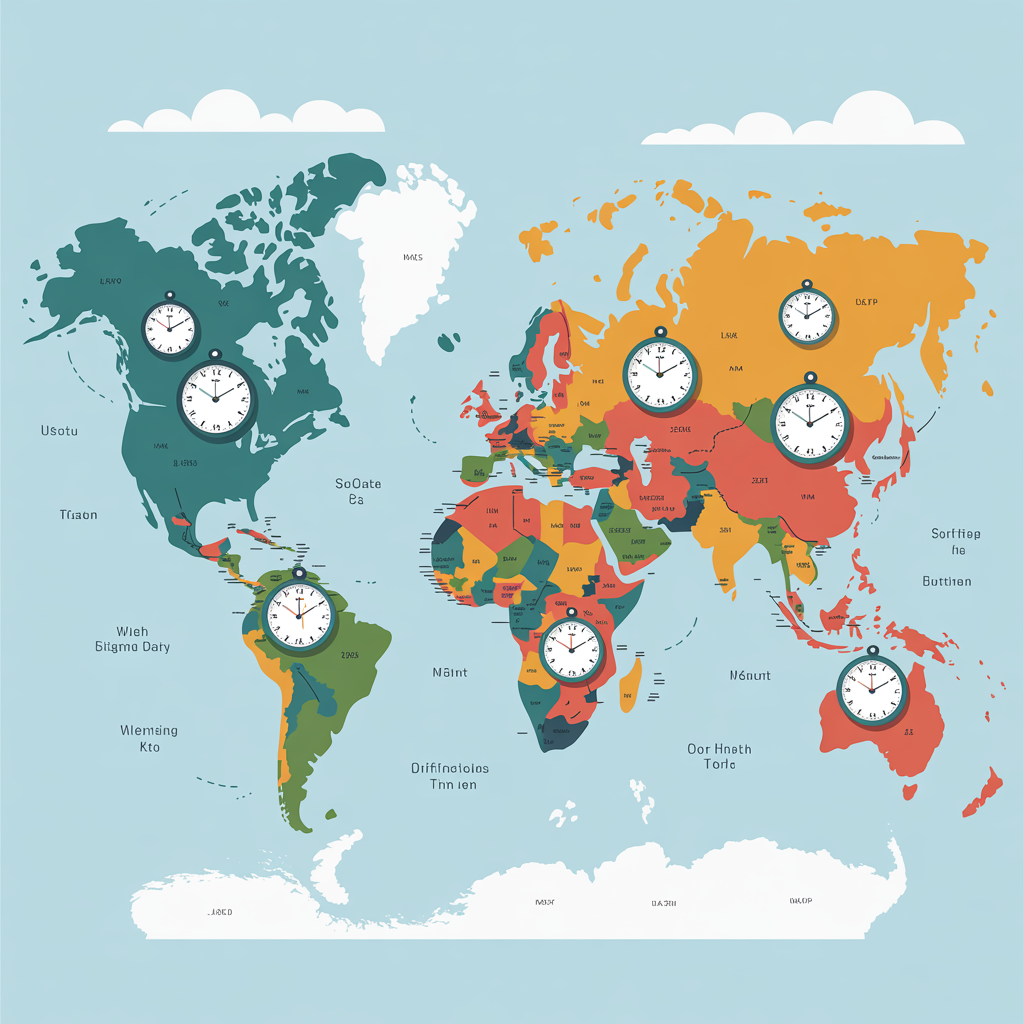
Navigating the complexities of time zones can be a challenge, especially when calculating time differences across the globe. Understanding how UTC and Greenwich Mean Time (GMT) play into this equation is essential, particularly with the added complexity of daylight saving time. In this article, we’ll explore how time zone converters work, provide step-by-step methods for calculating time differences, and highlight practical applications to enhance your global interactions.
Definition and Importance
A time zone is a region of the Earth that has the same standard time, which is critical for coordinating events across different locations.
Understanding time zones is essential for international business meetings and travel planning.
For instance, Eastern Time (ET) is 3 hours ahead of Pacific Time (PT), meaning a meeting scheduled at 2 PM ET would be at 11 AM PT. Tools like World Time Buddy or Google Calendar can help convert these times effortlessly.
When scheduling with international teams, specify the time zone to avoid confusion-“Let’s meet at 10 AM GMT (Greenwich Mean Time)” ensures everyone is aligned regardless of their location, especially across national borders.
Historical Background
The concept of standardized time zones emerged in the 19th century to address scheduling conflicts in railway systems, ultimately leading to the establishment of Greenwich Mean Time (GMT).
Before this standardization, local mean time was used, resulting in significant confusion as trains scheduled across various regions arrived at different times, leading to delays and accidents.
The introduction of the telegraph further necessitated a unified time concept for better coordination. In 1884, the International Meridian Conference established GMT as the world’s time standard, formalizing its use in navigation and commerce.
This change profoundly influenced time management, enabling synchronized operations in transportation, communication, and business across regions, marking a pivotal evolution in modern society, assisted by portable chronometers and railway time.
Understanding UTC and GMT
Coordinated Universal Time (UTC) and Greenwich Mean Time (GMT) are vital for global synchronization, each serving unique roles in timekeeping, with time signals and atomic clocks ensuring precision.
What is Coordinated Universal Time (UTC)?
Coordinated Universal Time (UTC) is the primary time standard by which the world regulates clocks and time, determined using atomic clocks.
UTC relies on highly precise atomic time, which measures vibrations of atoms (commonly cesium) to maintain accuracy. To account for Earth’s irregular motion, leap seconds are added or subtracted as needed.
This system is vital for global scheduling, ensuring that events like international flights and diplomatic meetings occur at synchronized times.
For example, a conference scheduled for 14:00 UTC will be the same worldwide, allowing participants from different time zones to join seamlessly, regardless of local time differences.
Greenwich Mean Time (GMT) Explained
Greenwich Mean Time (GMT), traditionally used as a time reference, has been largely replaced by UTC but remains relevant during daylight saving time changes.
GMT is a time standard that historically helped coordinate worldwide time. In contrast, Coordinated Universal Time (UTC) is based on atomic time and serves as a more precise reference.
During daylight saving time, regions may move their clocks forward, which can complicate scheduling across different zones. For instance, the UK shifts from GMT (UTC+0) to British Summer Time (BST, UTC+1), while New York transitions from EST (UTC-5) to EDT (UTC-4).
Understanding these differences is crucial for planning meetings or events across time zones.
How Time Zone Converters Work
Time zone converters utilize mathematical calculations to adjust local times based on geographical areas and standard time zones.
Basic Principles of Time Conversion
Time conversion relies on understanding the geographical longitude of locations and the difference from UTC or GMT.
To convert time accurately, first identify the longitude of your location; each degree of longitude corresponds to four minutes of time. For example, if you are at 30 degrees W longitude, your local time would be four hours behind UTC (30 degrees/15 degrees = 2; 2 x 4 = 8 hours).
If coordinating meetings across time zones, note the time difference: New York (UTC-5) and London (UTC+0). To calculate, simply add or subtract the differences, ensuring you account for Daylight Saving Time when applicable.
This method provides a reliable foundation for effective time management across regions.
Common Tools and Software
Several tools facilitate time conversion, including Classic Time Zone Converter and World Time Buddy, which provide user-friendly interfaces for quick calculations.
For more advanced capabilities, consider using Time Zone Converter Pro, which allows setting multiple time zones simultaneously and provides intuitive graphical displays of time overlaps.
Another option is The Time Zone App, which includes a mobile-friendly version perfect for travelers, allowing for easy onsite adjustments.
When choosing a tool, assess your needs: for example, if you require quick conversions on the go, a mobile app like The Time Zone App is ideal.
Store bookmarked links for easy access and save time in your daily planning.
Calculating Time Differences
Calculating time differences accurately is essential for scheduling meetings, especially when dealing with multiple time zones globally.
Step-by-Step Calculation Method
To calculate time differences, follow these steps:
- Identify the reference time zone.
- Determine the target time zone.
- Calculate standard time difference.
- Adjust for daylight saving time if applicable. For example, Eastern Time (ET) is typically 3 hours ahead of Pacific Time (PT).
- If it’s 3 PM ET during standard time, it’s 12 PM PT.
- In the summer, both zones observe daylight saving time, so the calculation remains the same.
Common errors to avoid include forgetting to consider DST and confusing AM with PM, which can lead to significant discrepancies. Always double-check your calculations with a reliable online Time Converter Tools.
Real-World Examples
For instance, a business meeting scheduled at 10 AM EST would require attendees in PST to join at 7 AM, illustrating the need for accurate calculations.
In personal communication, consider a family video call between New York (EST) and Los Angeles (PST) set for 8 PM. This means it will be just 5 PM for relatives on the West Coast.
Similarly, if a flight departs from London (GMT) at noon and heads to Tokyo (JST), the arrival time will be 9 PM the next day, as Japan is 9 hours ahead.
Utilizing world clock apps like Time Zone Converter or World Time Buddy can simplify these calculations, ensuring everyone is on the same page.
Challenges in Time Zone Conversion
Time zone conversion presents several challenges, particularly with Daylight Saving Time adjustments and regional variations.
Daylight Saving Time Adjustments
Daylight Saving Time (DST) adjustments can complicate time calculations, especially in regions that don’t observe DST.
For instance, the United States and Canada observe DST, shifting clocks forward one hour in spring and back in fall, while countries like China and India do not adopt this practice, maintaining a consistent time year-round.
To manage time changes effectively, utilize digital tools like smartphone calendar apps that automatically adjust for DST, along with traditional time zone tools like a time zone map or world clock converter.
When scheduling international meetings, confirm the local time zone for all participants to avoid confusion, taking note of the specific dates when DST begins and ends in each relevant locale.
Regional Variations and Exceptions
Some regions have unique time zone exceptions that can disrupt standard calculations, such as half-hour time differences in India.
For instance, India operates on Indian Standard Time (IST), UTC+5:30, differing from many countries that have whole hour offsets. Countries like Iran (UTC+3:30) and Afghanistan (UTC+4:30) also utilize half-hour deviations.
Regions in Newfoundland, Canada, operate at UTC-3:30. When planning global meetings or deadlines, using tools like World Time Buddy or Time Zone Converter can help navigate these variations effectively, ensuring accurate scheduling across diverse time zones.
Practical Applications of Time Zone Converters
Time zone converters are invaluable tools for travel planning and managing business operations across international borders.
Travel Planning
Effective travel planning requires awareness of time zone differences to avoid scheduling mishaps and ensure smooth itineraries.
To utilize time zone converters effectively when booking flights and scheduling events, follow these tips:
- First, check the current time in both your departure and destination zones, using tools like Time.is or World Time Buddy.
- Second, factor in Daylight Saving Time changes, as these can shift your plans suddenly.
Create a sample itinerary: for example, if flying from New York (EST) to London (GMT), schedule a meeting for 10 AM local time in London, which is 5 AM in New York, allowing ample time for adjustments.
Business Operations Across Borders
For businesses operating across borders, understanding time zone differences is essential for optimizing workflows and improving communication.
To effectively manage international teams, tools like World Time Buddy and Timeanddate.com are invaluable for scheduling meetings across different zones.
Companies like GitLab and Buffer excel in this area by fostering asynchronous communication and effective time synchronization-utilizing platforms such as Slack and not relying solely on real-time meetings.
GitLab adopts a `best time for all’ policy, enabling team members to find suitable times for collaboration. Implementing clear guidelines for project timelines, availability, and deadlines can further enhance coordination, ensuring that everyone stays aligned despite geographical barriers.
Summary of Key Points
Mastering time zones, including UTC and Greenwich Mean Time (GMT), enhances global communication and scheduling efficiency, especially with daylight saving time manipulation.
To effectively manage time zones, utilize tools like Google Calendar for automatic time zone adjustments when scheduling events, or use a classic Time Zone Converter for manual adjustments.
For team collaboration, platforms such as World Time Buddy and a time zone calculator allow you to compare multiple time zones, including eastern, central, mountain, and pacific time zones, at a glance.
Consider adopting the ISO 8601 standard for timestamp formatting, as it avoids confusion over AM/PM distinctions and regional differences, making it essential for international time management.
Always specify time zones in your communications to eliminate ambiguity, ensuring everyone is on the same page, regardless of their location, whether they’re in the United Kingdom, United States, Canada, Germany, China, India, Russia, Japan, Australia, or even Nepal.
Frequently Asked Questions
What is a time zone converter and how does it calculate time differences?
A time zone converter is an online tool or application that determines the current time in different geographical regions worldwide relative to a chosen reference point. It calculates time differences by using a database of global time zones, considering their offsets from Coordinated Universal Time (UTC) and factoring in any daylight saving time adjustments specific to each location.
What is the difference between Coordinated Universal Time (UTC) and Greenwich Mean Time (GMT)?
UTC (Coordinated Universal Time) is the primary time standard by which the world regulates clocks and time, based on atomic clocks. GMT (Greenwich Mean Time) is a time zone used in some countries, historically the basis for timekeeping. While often used interchangeably, GMT is technically a time zone, whereas UTC is a more precise, atomic standard from which all other time zones are derived.
How do time zone converters account for daylight saving time?
Time zone converters account for daylight saving time (DST) by incorporating a comprehensive database that tracks when and where DST is observed globally. When a user selects a location, the converter checks if that region is currently observing DST and automatically adjusts the time offset by an hour (or other specified period) if applicable, ensuring the displayed time is accurate.