



This comprehensive analysis examines the landscape of artificial intelligence tools available for K-12 and higher education classrooms, synthesizing evidence from over 60 sources to identify which solutions deliver the greatest pedagogical value, accessibility, and educational outcomes. The research reveals that the most effective AI tools for classrooms fall into distinct categories serving different educational functions: instructional design and lesson planning platforms like Brisk Teaching and MagicSchool.ai that integrate seamlessly into existing teacher workflows; personalized learning systems including adaptive platforms and intelligent tutoring systems that tailor instruction to individual student needs; specialized assessment and feedback tools that streamline grading while providing meaningful student support; and assistive technology solutions that expand educational access for students with disabilities. Current evidence demonstrates that AI-enhanced learning environments produce measurable improvements in student outcomes, with studies reporting 15-35% gains in academic performance, 54% higher test scores in active learning settings compared to traditional instruction, and significant increases in student engagement and motivation. However, successful implementation requires careful attention to data privacy compliance with federal regulations such as FERPA and COPPA, professional development for educators, and deliberate design choices that preserve valuable human interactions while leveraging AI’s capacity for personalization and automation. The most effective schools adopt a strategic, phased approach to AI integration, starting with teacher-focused tools that reduce administrative burden, then expanding to student-facing applications only after establishing clear policies, obtaining appropriate consent, and ensuring equitable access across all student populations.
The Emerging Landscape of Artificial Intelligence in K-12 Education
The integration of artificial intelligence into K-12 classrooms has accelerated dramatically over the past three years, transforming from a speculative future possibility into an immediate educational reality. According to recent surveys conducted by the Center for Democracy and Technology in the 2024-25 school year, eighty-five percent of teachers and eighty-six percent of students reported using AI tools in their classrooms, representing a profound shift in educational technology adoption across the United States. This rapid proliferation reflects both the genuine pedagogical potential of AI applications and the increasing pressure on educators facing resource constraints, teacher shortages, and declining student achievement levels that have reached their lowest points in nearly two decades. The urgency of these challenges has created an environment where administrators and teachers seek technological solutions that can help personalize instruction, automate time-consuming administrative tasks, and provide students with individualized support that traditional classroom structures struggle to deliver.
The range of AI tools now available to educators spans an unprecedented breadth of educational functions and contexts. From platforms that help teachers design entire units and lessons to tools that provide real-time transcription and note-taking during lectures, from systems that adapt mathematics instruction to individual student mastery levels to applications that create immersive virtual reality field trips, the AI landscape offers solutions for nearly every aspect of the educational process. However, this abundance of choice creates its own challenges for educators and administrators tasked with selecting tools that will genuinely improve learning outcomes while fitting within existing school systems, complying with privacy regulations, and not exceeding technology budgets. The question of which AI tools are “best” for classrooms cannot be answered with a single recommendation but rather requires a systematic analysis of different educational needs, implementation contexts, teacher skill levels, and student populations.
Research increasingly demonstrates that AI tools can deliver meaningful educational benefits when implemented thoughtfully and aligned with pedagogical best practices. A comprehensive systematic review analyzing twenty-one empirical studies published between 2015 and 2025 found that the majority of research reports substantial improvements in academic performance, engagement, and knowledge retention among students using AI-supported systems. The performance gains documented in these studies ranged from 15 percent to 35 percent, with increased task completion efficiency and higher learner satisfaction representing consistent findings across multiple studies employing different methodologies, populations, and subject areas. Additionally, students in AI-enhanced active learning programs achieve 54 percent higher test scores than those in traditional environments, and AI-powered active learning generates 10 times more engagement than traditional passive learning methods. These findings suggest that the question facing educators is not whether AI should be integrated into classrooms, but rather how to select, implement, and manage AI tools in ways that maximize benefits while minimizing risks related to student privacy, data security, and the quality of human interactions that remain central to effective teaching.
Specialized AI Tools for Instructional Design and Lesson Planning
Among the most immediately valuable AI applications in education are tools designed specifically to support teachers in the essential but time-consuming work of instructional planning, curriculum development, and materials creation. Teachers consistently report spending extensive hours on lesson planning, rubric development, and material preparation—work that, while necessary, can limit the time available for actual instruction, student interaction, and professional reflection. Brisk Teaching, which functions as a Google Chrome extension that integrates with existing teacher tools including Google Classroom, Docs, Slides, YouTube, Canvas, and increasingly Microsoft applications, has emerged as one of the most widely adopted teacher-facing AI solutions. The platform distinguishes itself through its seamless integration into the existing digital workflows that teachers already use daily, eliminating the friction of learning a new system while providing access to more than forty different AI-powered tools in its free version. Brisk Teaching enables educators to generate quizzes, slide shows, differentiated content at multiple reading and complexity levels, lesson plans, guided notes, personalized feedback on student writing, and custom learning activities including subject area tutors and interactive historical figure conversations, all without leaving the platforms teachers are already using.
The design philosophy underlying Brisk Teaching reflects a critical insight about educational technology adoption: teachers are more likely to use tools that extend their existing workflows rather than tools requiring them to adopt entirely new systems or learn unfamiliar interfaces. By functioning as an extension of Google Workspace and Microsoft tools that schools have already invested in, Brisk removes a significant barrier to adoption. The platform’s paid version provides access to a more powerful AI model without usage limits and includes additional features, making it scalable for teachers who want to use AI more extensively. Research involving over 20,000 districts indicates that teachers using Brisk Teaching report substantial time savings and improved ability to differentiate instruction for students at different learning levels, while the platform’s privacy certifications and 93 percent Common Sense Privacy Rating provide assurance to schools concerned about data security.
MagicSchool.ai and Eduaide.AI similarly target the lesson planning and instructional materials creation space but with somewhat different positioning and feature sets. MagicSchool.ai emphasizes that the platform includes over eighty teacher-specific tools, allows teachers to create lesson plans, rubrics, assessments, and student resources in minutes rather than hours, and provides real-time student learning insights to help educators understand which concepts students are struggling with and what interventions might be most effective. The platform integrates directly with Google Docs, Google Classroom, Canvas, and Microsoft applications, ensuring that teachers can access AI assistance within their familiar learning management systems rather than having to navigate to external websites. Districts implementing MagicSchool.ai report an average time savings of 7-10 hours per week for teachers, along with improvements in student achievement, with 28 percent of students meeting literacy grade-level expectations after implementation.
NotebookLM represents a different approach to AI-supported instructional design by focusing on the challenge of managing and leveraging the diverse information resources that teachers use to teach—including slide presentations, audio files, Google Docs, PDFs, websites, and YouTube videos. Rather than generating new content, NotebookLM allows teachers to upload up to fifty different sources into a single collection called a “notebook” and then asks the AI to generate educational content including Depth of Knowledge leveled questions, study guides, frequently asked questions lists, and timelines, all based specifically on the resources the teacher has selected and vetted. Importantly, NotebookLM also generates audio summaries in the form of simulated podcasts featuring two AI cohosts who explain the submitted content in an engaging, easy-to-understand format. These podcasts can be downloaded or shared as links with students, providing an alternative format for content review that can support students with different learning preferences and can particularly benefit students with visual impairments or reading challenges. The free version of NotebookLM allows educators to create up to 100 notebooks with 50 sources each, making it accessible even to teachers with limited budgets.
TeacherServer, operated by the University of South Florida St. Petersburg and therefore offered completely free without advertisements or subscription fees, provides access to over one thousand AI tools spanning science, social studies, mathematics, reading, writing, art, music, and physical education. The platform simplifies the process of generating AI outputs by asking teachers to provide a few key details—such as grade level, topic, and educational standard being addressed—and then producing lesson plans, rubrics, assessment questions, and more. Unlike simple rubric generators, TeacherServer can generate ideas for scientific experiments, create historical what-if scenarios, analyze texts for tone and mood, and design exercise routines, offering educators a broad palette of AI capabilities without the complexity of learning to craft sophisticated prompts or navigating multiple different platforms.
AI Tools for Assessment, Feedback, and Automated Grading
Among the most time-consuming aspects of teaching is the process of assessing student work, providing meaningful feedback, and maintaining records. Teachers frequently report that grading and providing written feedback consumes 5-10 hours of their week, time that could otherwise be devoted to planning, professional development, or direct student interaction. Several specialized AI tools have emerged to address this bottleneck in the teaching process. Snorkl specifically targets assessments that benefit from oral, handwritten, or drawn responses—modalities that are difficult for traditional automated grading systems to evaluate. The platform allows teachers to create assignments where students can submit responses via speaking, handwriting, or drawing, with Snorkl then grading those responses in typically less than a minute and providing three separate statements offering personalized assessment of answer accuracy and explanation quality. This capability addresses a significant gap in existing assessment technology, as teachers often struggle to efficiently assess work that demonstrates understanding through nontraditional modalities, meaning that such assignments have been underutilized despite their pedagogical value.
Gradescope has become the dominant platform for handling the comprehensive assessment pipeline, particularly for fixed-template assignments including problem sets, projects, worksheets, quizzes, bubble sheets, and exams. The platform’s core innovation involves allowing teachers to grade paper-based, digital, or code assignments in approximately half the time required by traditional methods, while maintaining consistency through flexible rubrics that can be applied across many student submissions. Critically, Gradescope’s artificial intelligence features include answer grouping, where the system automatically identifies similar student responses and groups them for evaluation, dramatically reducing the time required to grade when many students have provided similar answers to an open-ended question. Teachers report that Gradescope’s AI-assisted grading and answer grouping features can reduce by ten minutes what would typically take an hour to grade by hand—a substantial time savings that multiplies across a teacher’s multiple classes and daily assessments. The platform also provides detailed per-question and per-rubric statistics, enabling teachers to understand which concepts students are struggling with and identify potential areas for re-teaching or additional support.
Feedback Fruits addresses the assessment challenge through a different mechanism, providing automated feedback on student writing across twenty-plus different writing criteria including clarity, structure, citations, grammar, tone, and more. The platform can detect missing citations, incorrect referencing formats, and citation count issues, helping students understand academic integrity expectations and correct their work before final submission. When integrated as a pre-step in the assignment submission pipeline, Automated Feedback allows students to receive immediate, actionable suggestions that they can incorporate into revised drafts, transforming feedback from a summative grading tool into a formative support mechanism that guides student learning. Teachers report using the platform to reduce repetitive corrections they would otherwise have to provide across many student submissions, freeing them to focus on providing deeper, more personalized guidance to individual students who need it most.
For writing assessment and improvement beyond the classroom context, tools like Grammarly, ProWritingAid, Turnitin, and Paperpal provide students with sophisticated writing support that goes far beyond simple spell-checking. Grammarly offers real-time assistance with English grammar, spelling, and tone detection, includes a plagiarism detector to catch unintentional academic integrity violations early in the writing process, and provides contextual feedback on writing style and tone that helps students adapt their writing to different audiences and purposes. Teachers report that having students use Grammarly during the writing process, before submitting work for formal grading, results in higher quality submissions and allows them to focus feedback on substantive issues of argument, evidence, and clarity rather than mechanical errors. Turnitin, primarily known as a plagiarism detection tool, provides detailed originality reports that help educate students about proper citation techniques and identify both intentional plagiarism and unintentional violations of academic integrity. Paperpal, specifically designed for academic writing, features a research-backed grammar checker, paraphraser, plagiarism checker, and AI writing tool, along with access to scientific research articles and citation generation across 10,000 styles, making it particularly valuable for higher education and students writing research-based assignments.
Adaptive Learning Systems and Personalized Instruction Platforms
While tools for teacher administrative support address one critical bottleneck in education, adaptive learning systems and personalized instruction platforms represent an equally important category of AI tools that directly support student learning by customizing educational content and pacing to individual learner needs. The theoretical foundation for this approach rests on decades of educational research demonstrating that students learn more effectively when instruction is appropriately challenging—neither so easy as to be boring nor so difficult as to be frustrating—and when they receive immediate feedback on their efforts. Traditional teacher-directed instruction faces inherent constraints in providing this level of customization at scale: a teacher cannot simultaneously monitor the exact performance of thirty different students, identify the precise point at which each student needs additional support or challenge, and adjust instruction in real time for each individual.
Adaptive learning platforms like ALEKS and IXL employ artificial intelligence to overcome these constraints by continuously monitoring student performance across thousands of fine-grained skill assessments, identifying exactly which concepts each student has mastered, which require additional practice, and which prerequisite skills need to be solidified before advancing to more complex topics. These systems adapt in real time, adjusting the difficulty and type of problems presented based on student responses, ensuring that each student encounters content calibrated to their current knowledge level. Research indicates that students using well-designed adaptive learning systems demonstrate 15-35 percent improvements in academic performance compared to traditional instruction, complete tasks 25 percent more efficiently, and report higher satisfaction with their learning experiences. The systems are particularly effective in mathematics and sciences, where there are clear prerequisite skills and sequential learning progressions, though newer adaptive systems are extending these capabilities to other subject areas including language arts and social studies.
Khan Academy’s Khanmigo represents a more recent entrant into the adaptive learning space, built on the foundation of Khan Academy’s extensive library of instructional videos and practice problems. Khanmigo functions as an AI-powered teaching assistant that guides students toward discovering answers themselves rather than providing direct answers, operating on the principle that genuine learning requires active problem-solving rather than passive reception of information. For teachers, Khanmigo for Teachers, now available free to all United States teachers with support from Microsoft, provides access to tools for lesson planning, rubric creation, and personalized instruction recommendations. The platform’s pedagogical approach—emphasizing guided discovery over direct instruction—reflects growing research evidence that students develop deeper understanding and better retention when they must work through problems actively, with support available when they get stuck, rather than when they receive fully worked examples.
The microschool model exemplified by Alpha School demonstrates how AI-powered adaptive learning can be integrated into a comprehensive educational model that preserves the human elements essential to education while leveraging AI’s capacity for personalization at scale. At Alpha School, students spend approximately two hours each morning working through AI-powered math modules and other academic content, with an AI tutor providing immediate feedback, identifying gaps in understanding before presenting new concepts, and adapting the pacing to each student’s demonstrated mastery level. Teachers, referred to as “guides,” circulate during these sessions to answer questions, maintain focus, and provide encouragement. Once students complete their core academic work—often in just two hours through the AI-powered system, compared to the full day in traditional school—they transition to the afternoon, where guides facilitate collaborative projects, workshops, and skill-building activities that develop communication, leadership, and problem-solving abilities. This structure demonstrates that adaptive AI systems need not eliminate teacher-student relationships or collaborative learning; rather, they can free teachers from the need to deliver whole-class instruction at a predetermined pace, allowing them to focus their expertise on mentorship, facilitation of complex projects, and support for social-emotional development.
SchoolAI similarly positions AI as a partner to teachers rather than a replacement, with its “Spaces” functioning as personalized learning environments where students work with an AI learning companion called Dot. Each Space adapts to individual learning styles and paces, and Dot provides real-time encouragement, hints, and emotional support, including detecting signs of frustration based on interaction patterns and offering motivational prompts when students appear to be struggling. The platform’s research indicates that students using SchoolAI show improvements in meeting literacy grade-level expectations, achieve 70 percent better course completion rates with AI-personalized learning compared to traditional approaches, and demonstrate 12 percent increases in school attendance when their education feels personally relevant and appropriately paced. Teachers working with SchoolAI spend significantly less time on administrative tasks and report being able to focus more of their time on meaningful student interventions, differentiated instruction, and deep engagement with learners.
Assistive Technology and AI Support for Students with Disabilities
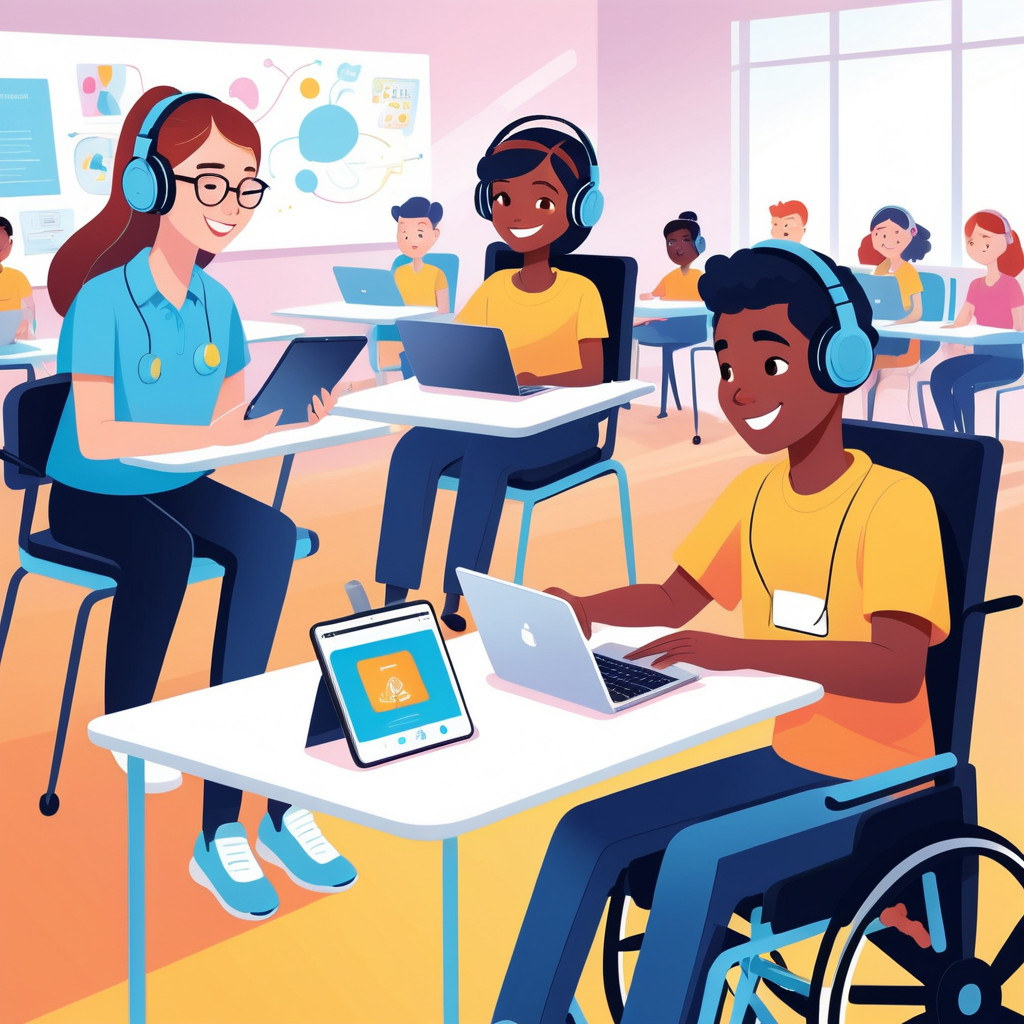
One of the most promising applications of artificial intelligence in education involves the development of assistive technologies that can help students with disabilities access educational content, communicate more effectively, and participate fully in classroom learning. The impact of AI in special education extends far beyond simple accessibility accommodations—it represents a fundamental transformation in how students with significant learning differences can engage with academic content and demonstrate their knowledge. For students with dyslexia, sophisticated AI-powered text-to-speech systems like ReadSpeaker and Speechify allow them to listen to written text while following highlighted passages, dramatically improving reading comprehension while eliminating the need to spend cognitive resources on the decoding process itself. Students using these tools can stay at grade level in all subjects rather than becoming progressively more behind as texts become longer and more complex, a particularly critical advantage as students advance through middle and high school where reading demands increase substantially.
For students with speech difficulties or complex motor impairments affecting communication, AI-powered speech recognition systems like Voiceitt can learn to understand speech patterns that might be difficult for others to comprehend, enabling students to participate in classroom discussions and complete speaking assignments. These programs improve over time as they learn each student’s unique speech characteristics, becoming increasingly accurate and responsive to that individual’s needs. Students with motor impairments affecting writing can use eye-tracking technology combined with predictive text tools that anticipate their needs, allowing them to compose written assignments independently rather than requiring constant adult support. For students who are deaf or hard of hearing, AI-driven real-time transcription of classroom audio and increasingly sophisticated transcription accuracy means that students can participate more fully in discussions and lectures without relying entirely on sign language interpreters or missing portions of conversation.
Beyond these direct assistive applications, AI tools are creating dynamic and engaging learning environments that adapt to students with special needs in ways that were previously impossible. For a student with dyscalculia who struggles with mathematical concepts, an AI-powered math program can observe their work patterns, identify exactly where the learning process breaks down, and then present information through different approaches—using visual representations, real-world examples, or interactive games—until it finds the method that resonates best with that particular student. An AI system might notice that a student consistently struggles with fraction problems and decide to ensure they fully understand the concept of whole numbers and division before introducing fractions, essentially building a customized learning sequence tailored to that individual’s specific knowledge gaps.
Educational platforms increasingly incorporate multisensory learning approaches that combine visual, auditory, and interactive elements to create rich learning experiences that adapt to each student’s preferred modality of engagement. A history lesson about ancient Egypt, for example, might combine traditional text with interactive 3D models of pyramids that students can explore virtually, adaptive quizzes that adjust difficulty based on student responses, virtual reality experiences that bring historical events to life, voice-controlled navigation for students with motor limitations, and real-time translation of hieroglyphics to aid understanding. This level of customized multisensory support would be impossible without AI systems to manage the complexity and adapt in real time based on individual student interactions.
The integration of AI in assistive technology also supports neurodivergent learners and students with emotional or social challenges. Text-to-speech tools help students with attention deficit or concentration difficulties by supporting sustained focus on complex material. Predictive typing features and speech-to-text technologies streamline communication for students with language disabilities, reducing the cognitive load of translating thoughts into written or spoken form. Microsoft Copilot and similar tools can assist students who are colorblind by converting color-based data in charts into accessible formats. While AI technology for recognizing and responding to facial expressions remains under development, emerging research suggests that AI-powered robotic assistants might eventually help students with physical challenges or social-emotional difficulties.
Tools for Engagement, Discussion, and Interactive Learning
Beyond the direct provision of adaptive instruction or skill practice, AI tools increasingly support the interactive and collaborative aspects of learning that research consistently identifies as essential for developing deeper understanding and critical thinking skills. Parlay is an AI-powered instructional platform specifically designed to help teachers facilitate meaningful, measurable, and inclusive class discussions. The platform creates “RoundTables” that function as threaded discussion boards supercharged with features including secret identities allowing students to participate anonymously if they choose, guided peer feedback questions that help students give constructive responses to classmates, model submissions that demonstrate high-quality responses, and crucially, an AI-powered tool called Parlay Genie that reads student contributions, videos, and past Parlay discussions to generate higher-order discussion prompts and follow-up questions in seconds. Teachers report that Parlay significantly improves the quality of classroom discussions by ensuring that every student has an opportunity to contribute, by maintaining an accessible record of who said what throughout the year, and by providing intelligent follow-up questions that deepen student thinking.
Kialo Edu provides another model for promoting deep, structured discussion and critical thinking through a free platform that allows students to contribute pros and cons for each other’s points, creating an interactive discussion map that shows how different ideas link together. The platform’s text-based format and optional anonymous mode help students who find traditional verbal discussions daunting to participate at their own pace and with more time to formulate thoughtful responses. Because Kialo discussions are automatically saved and can be graded, teachers have a complete record of student thinking and participation that is far more comprehensive than traditional class discussion records. Students using Kialo have reported that the platform helps them understand how different ideas connect and encourages intellectual engagement by making the logical structure of an argument visible and explicit.
Nearpod enables teachers to create interactive presentations that include polls, quizzes, videos, and other interactive elements that keep students engaged throughout instruction while simultaneously allowing teachers to check for understanding in real time. The platform provides immediate feedback to students about their quiz performance, identifies misconceptions the teacher can address immediately, and allows for flexible differentiation through station-type activities that promote student movement and provide variety in learning modalities. By eliminating the traditional lecture format where students sit passively while a teacher or video presents information, Nearpod keeps students actively engaged, responsive, and participatory throughout the lesson.
For creative expression and multimedia content creation, Canva Education provides free access to a comprehensive visual design suite for all K-12 students and teachers at eligible schools. Students can use Canva to create compelling visual presentations, design infographics, produce videos, and develop websites, transforming assignments from text-based essays to multimodal demonstrations of learning that engage creative expression alongside critical thinking. Teachers report that Canva increases student engagement and confidence by allowing students to produce work that looks professional and visually compelling even without advanced design skills, and research indicates that visual design projects promote deeper understanding by requiring students to synthesize and reorganize knowledge in new formats.
Runway for Education brings AI-powered video and image generation into creative and technical curricula, with the platform already incorporated into design and filmmaking programs at UCLA, NYU, USC, and Harvard. The platform provides educators with curriculum support materials, discounted resources for classroom use, and a student ambassador program that gives selected students complimentary access and credit allowances, making sophisticated media generation tools available to students who would otherwise not have access to these technologies due to cost.
Research Evidence on AI Effectiveness in Education
The investment in AI tools for education is justified by accumulating research evidence demonstrating genuine improvements in student learning outcomes, engagement, and completion rates. A systematic review of twenty-one empirical studies published between 2015 and 2025 examining the effectiveness of AI-driven tools—specifically adaptive learning platforms and intelligent tutoring systems—found that the majority of studies report substantial improvements in academic performance, engagement, and knowledge retention. Across these diverse studies, performance gains ranged from 15 percent to 35 percent, with increased task completion efficiency and higher learner satisfaction representing consistent findings. Quasi-experimental studies, which are considered stronger evidence than observational studies, reported particularly strong gains, with AI-supported students outperforming peers by 15 to 35 percent on assessments while also showing greater engagement and satisfaction.
More specific findings demonstrate the magnitude of AI’s impact in particular domains. Students in AI-enhanced active learning programs achieve 54 percent higher test scores than those in traditional environments, with this improvement spanning multiple subjects including mathematics, science, language arts, and social studies. The improvement persists on standardized assessments designed independently of the AI-enhanced learning environments, suggesting that AI benefits are not artifact of AI systems being calibrated to AI assessments. AI-powered active learning generates 10 times more engagement than traditional passive learning methods, a finding that reflects both the interactive nature of AI-supported learning and the increased relevance that comes when instruction is customized to individual interests and learning levels. AI-powered assessment tools provide feedback that is 10 times faster than traditional methods, allowing students to correct misconceptions while material remains fresh in their minds rather than waiting weeks for graded papers to be returned by teachers.
The magnitude of these effects is particularly striking when compared to effect sizes associated with other educational interventions. A 30 percent improvement in learning outcomes far exceeds the impact of most classroom-based interventions studied in education, and a 54 percent difference in test scores represents a shift from below-average to above-average performance for many students. The increased engagement generated by AI systems is perhaps equally important, as research consistently demonstrates that students who are engaged with learning material develop deeper understanding and better retention than passive learners regardless of content difficulty.
At the personal level, students using AI-enhanced systems report substantial subjective benefits that complement the objective performance improvements. Seventy-five percent of students feel more motivated in personalized AI learning environments compared to only 30 percent in traditional classrooms, reflecting both the increased relevance that comes from personalization and the enhanced sense of autonomy and control students feel when they can progress at their own pace. Schools implementing AI-powered personalized learning observed a 12 percent increase in student attendance, suggesting that when educational content aligns with individual interests and learning styles, students find school more valuable and worthwhile. Educational institutions implementing AI early warning systems observed a 15 percent reduction in student dropout rates, as early identification of at-risk students enables educators to provide targeted support before students become discouraged enough to consider leaving school entirely.
Implementation Challenges: Privacy, Data Security, and Ethical Concerns
Despite the promising evidence regarding AI’s educational potential, implementation in real schools faces substantial challenges related to privacy, data security, ethical use, and the preservation of equitable access. The use of AI in education necessarily involves collecting and analyzing student data—information about what students know and don’t know, how quickly they learn, what kinds of mistakes they make, and personal characteristics that might affect their learning. Ensuring the confidentiality and security of this sensitive information is paramount and requires educational institutions to implement robust protection measures that comply with applicable privacy regulations. In the United States, this compliance landscape is complex and evolving, with at least three major federal laws governing school AI use and data handling.
The Family Educational Rights and Privacy Act, enacted in 1974 but last significantly updated before widespread educational technology adoption, protects the privacy of student education records and applies to all schools and education agencies receiving funding under an applicable program of the U.S. Department of Education. FERPA requires that schools obtain written consent before disclosing personally identifiable information about students, with certain exceptions for health and safety emergencies, transfers, and legal requirements. Critically for AI implementation, FERPA treats every piece of personally identifiable information in education records as confidential, meaning that simply removing student names from AI prompts does not constitute FERPA compliance if other information in the prompt could identify students or reveal sensitive information. For schools using AI platforms that need student data to personalize learning or track progress, FERPA requires formal vendor agreements clearly limiting how student data is used, enforcing strong security measures, and guaranteeing data deletion when requested by schools.
The Children’s Online Privacy Protection Act establishes specific requirements for operators of websites or online services that knowingly collect personal data from children under thirteen, primarily requiring direct parental or guardian notification and consent for the collection of personal information. When AI tools require individual student logins, schools must obtain verifiable parental consent first, regardless of whether the service is “directed at” children. In January 2025, the Federal Trade Commission finalized amendments to COPPA to address evolving digital practices, introducing requirements for separate parental consent before disclosing a child’s personal information to third parties, mandating that operators retain children’s personal information only as long as necessary to fulfill the purpose for which it was collected, and introducing stricter requirements for COPPA Safe Harbor programs.
Most recently, the TAKE IT DOWN Act establishes a “reasonable person” standard for determining authenticity of deepfake content and carries penalties up to three years in prison for violations, creating immediate obligations for schools to maintain systems for reporting and removing deepfake content, document response procedures and timelines, and train staff on recognition and removal protocols. These three overlapping regulatory frameworks create complex compliance requirements that schools must navigate to use AI legally and ethically.
Beyond regulatory compliance, AI systems can inadvertently perpetuate or amplify biases present in their training data or underlying algorithms. If the data used to train an AI system is biased or reflects historical inequities, the AI application will inadvertently perpetuate these biases, potentially leading to unfair or discriminatory practices. For example, if facial recognition training data overrepresents certain racial or ethnic groups, the system may perform poorly when identifying individuals from underrepresented groups, creating barriers for those students while potentially triggering false alarms for others. If writing evaluation models are trained primarily on writing from native English speakers, they may unfairly penalize multilingual writers using different rhetorical structures or vocabulary choices. Oversight and monitoring by educators and consistent updating of AI systems are necessary to reduce this risk, but require resources and expertise that many schools lack.
The question of reduced human interaction represents another concern about AI integration in education. While AI can simplify and accelerate certain tasks, it cannot replace the nuanced understanding and emotional support only human educators can provide. Overreliance on AI can diminish the essential human connection crucial for student development and well-being. Research by the Center for Democracy and Technology found that half of students agree that using AI in class makes them feel less connected to their teachers, and 47 percent of teachers and 50 percent of parents express concern about decreased peer-to-peer connections as a result of AI use. These concerns highlight the importance of using AI as a tool that enhances and frees up teacher-student time rather than as a replacement for teacher presence and attention.
Accessibility and equity issues compound these concerns, as not all students and schools have equal access to advanced technologies. If AI tools are not accessible to all learners—including students with disabilities, students from lower-income backgrounds without home internet access, and students in under-resourced schools—the digital divide can exacerbate existing educational inequalities. Ensuring equitable access to AI resources should be prioritized to ensure that their benefits are shared by all students rather than widening the gap between privileged and marginalized populations.
Best Practices for Successful AI Implementation in Schools
Schools that have successfully implemented AI tools report that the most important factor predicting successful adoption is beginning with deliberate planning and stakeholder engagement rather than rushing to adopt the latest tools. One critical best practice involves creating an AI awareness campaign to help faculty and staff understand which AI resources are available and allowed within their roles. Many schools lack clear guidelines about AI use, creating confusion about whether AI adoption is encouraged or discouraged. Providing transparent information about which tools are vetted and approved for use significantly increases adoption rates and reduces teacher hesitation.
Providing accessible, engaging resources to demystify AI is essential for reducing teacher fear and increasing comfort with these technologies. Many educators have significant, well-founded concerns about AI, including energy use, bias, intellectual property rights, privacy, labor implications, and more. Rather than dismissing these concerns, effective schools acknowledge them as legitimate, provide educators with opportunities to experience AI firsthand and understand its limitations, and create space for ongoing discussion about ethical use. The Office of Educational Technology provides comprehensive guidelines for AI implementation as a first step, but schools should also do their own research to determine resources that best support their particular context and community values.
Professional development programs specifically designed to upskill employees in AI technologies are essential, as effective AI integration requires educators to be proficient in using these systems. Given AI’s novelty and the rapid development of new applications, ongoing professional development remains necessary as teachers develop their skills beyond basic tool usage to more sophisticated applications that leverage AI’s full potential. Many teachers benefit from quick tips shared in faculty newsletters and professional learning community meetings, but comprehensive understanding develops through more intensive workshops, conferences, and sustained practice with AI tools.
Implementing pilot projects to demonstrate tangible benefits of AI for educators and students helps overcome resistance and build support for broader adoption. Rather than mandating that all teachers use AI tools immediately, effective schools start with educators or grade levels interested in AI and implement specific use cases that address genuine problems—such as personalizing learning recommendations for students or automating administrative tasks for teachers. Documenting and sharing success stories from early adopters creates momentum for adoption and helps skeptical colleagues envision how AI might benefit their particular classrooms.
Careful policy development provides essential guardrails for AI use while avoiding overly restrictive policies that might discourage beneficial applications. Some schools adopt a “traffic light” system for AI tools, where green tools like lesson planners and brainstorming aids receive pre-approval for immediate use, yellow tools including adaptive quizzes and analytics dashboards require written parent notification before implementation, and red tools such as automated essay grading and facial recognition systems remain off-limits until further review. This approach keeps decision-making transparent while empowering teachers to make informed choices quickly. Clear, well-articulated policies that distinguish between different uses of AI—allowing AI for personalized learning while prohibiting AI for high-stakes summative assessment without significant oversight, for example—help teachers understand what is and is not appropriate without creating blanket prohibitions that shut down beneficial uses.
Student inclusion in policy development processes increases both the appropriateness of policies and student understanding of why particular guidelines exist. When students participate in discussions about data privacy, algorithm bias, and responsible technology use, they develop the digital citizenship skills necessary for lifelong learning and civic participation. These conversations also help students understand that responsible technology use is not about restricting access to useful tools but about using them in ways that respect privacy, promote fairness, and benefit everyone.
Emerging Trends and Future Directions in Educational AI
The landscape of AI in education continues to evolve rapidly, with new capabilities and applications emerging constantly. One significant emerging trend is the integration of gamification with AI personalization, where AI systems adapt game mechanics—including points, badges, levels, and progress tracking—to individual learning needs, maintaining educational rigor while leveraging the motivational power of game elements. Research indicates that AI-powered gamification significantly improves both engagement and learning results by ensuring that game mechanics are appropriately calibrated to each student’s abilities and interests rather than providing generic rewards that lose their appeal over time.
Another important development involves the expansion of AI literacy education for students themselves. Rather than treating AI as a mysterious tool to be used by teachers and students without understanding how it works, forward-thinking schools are integrating AI ethics and literacy into curricula across subjects. Students are learning about bias in AI systems, understanding how their personal data is collected and used, exploring transparency and explainability in algorithms, grappling with moral considerations about AI applications, and considering the long-term impact of AI on society and jobs. By demystifying AI and teaching students about both its capabilities and limitations, schools prepare students not just to use AI tools but to think critically about AI’s role in society and to consider how to ensure it is used ethically and responsibly.
Professional development for educators in AI literacy is also expanding, with platforms like the free AI Literacy Essentials for K-12 course providing self-paced certification training that teaches educators what AI is and is not, how to write effective prompts, how to evaluate AI-generated content critically, and how to apply responsible practices protecting student data. Over 1,300 educators have already completed this course, and similar programs are being rolled out by districts seeking to build AI literacy across their teacher workforce.
Synthesizing Evidence into Practical Guidance
Based on the extensive evidence reviewed, educators and administrators seeking to select AI tools for their classrooms should prioritize tools that address genuine pedagogical problems—saving teacher time on administrative tasks, providing personalized instruction to students at different learning levels, supporting students with disabilities, or facilitating meaningful engagement and discussion—rather than adopting tools simply because they are novel or trendy. The most successful implementations begin with teacher-focused tools that reduce administrative burden, build teacher confidence with AI, and generate enthusiasm from early adopters. Tools like Brisk Teaching, which integrates into existing workflows, or MagicSchool.ai, which provides immediate time savings in lesson planning and feedback provision, prove particularly effective as entry points because they deliver measurable benefits with minimal disruption to existing practices.
As confidence and expertise develop, schools can expand to student-facing applications, beginning with tools that support rather than replace teacher judgment—adaptive learning systems that provide individualized practice while teachers retain responsibility for pacing and sequencing, or discussion platforms that facilitate more inclusive participation in classroom conversations without eliminating teacher-led instruction. Specialized tools addressing specific needs—assistive technologies for students with disabilities, plagiarism detection tools for supporting academic integrity, or assessment platforms that streamline grading—should be selected based on demonstrated effectiveness and careful alignment with school values and practices.
Equally important as tool selection is comprehensive planning for implementation, including professional development, clear policies, parent communication, and ongoing evaluation of impact. Schools that invest significant time in stakeholder engagement, provide robust professional development, and establish clear governance structures for AI use report far higher success rates than schools that simply distribute tools and expect teachers to figure them out independently. The most valuable question schools can ask when considering any AI tool is not “Is this the most sophisticated or cutting-edge application?” but rather “Does this tool address a genuine need in our school, do we have the capacity to implement it effectively and responsibly, and can we ensure equitable access for all our students?”
Curating Your Classroom’s AI Ecosystem
The landscape of AI tools for classrooms has evolved from speculative future possibility to immediate practical reality, with substantial evidence demonstrating that carefully selected and thoughtfully implemented AI applications can enhance teaching and learning, improve student engagement and achievement, support students with disabilities, and free teachers to focus on the human dimensions of education that technology cannot replicate. The question facing educators and administrators is no longer whether to integrate AI into schools, but rather how to do so in ways that maximize educational benefit while protecting student privacy, maintaining equitable access, preserving the human relationships central to meaningful education, and ensuring that AI serves the values and goals of each particular school community.
The most effective approaches to AI selection and implementation begin with a clear understanding of specific educational problems the school is trying to solve, followed by careful evaluation of available tools against criteria including pedagogical effectiveness, ease of integration into existing systems, privacy and security protections, accessibility for students with disabilities, cost, and alignment with school values. Teachers should be involved from the beginning in tool selection and implementation planning, as their expertise in understanding their students’ learning needs and their own workflow preferences is essential for choosing tools that will genuinely be used rather than tools that sit unused due to poor implementation or misalignment with classroom realities.
School leaders should prioritize providing comprehensive professional development for teachers using AI tools, clear and flexible policies that enable appropriate AI use while protecting against misuse, transparent communication with parents about how AI is being used and how their child’s data is protected, and ongoing evaluation of impact on student learning and well-being. By attending thoughtfully to these dimensions of implementation, schools can harness AI’s genuine potential to support more personalized, engaging, and effective education while preserving the human relationships, critical thinking development, and equity considerations that define excellent teaching and learning. The AI tools that will prove most valuable to classrooms over the coming years will not be those with the most sophisticated technology, but rather those that are designed with teachers and students as genuine partners, that address real problems in authentic ways, and that consistently demonstrate commitment to educational values and student welfare alongside technological innovation.
Frequently Asked Questions
What are the main categories of effective AI tools for classroom use?
Effective AI tools for classroom use fall into categories like personalized learning platforms (adaptive tutoring, individualized content), content creation and curation tools (AI assistants for lesson plans), assessment and feedback systems (automated grading, plagiarism detection), and administrative aids (scheduling). These tools enhance student engagement and boost teacher efficiency.
Which AI tools are recommended for lesson planning and instructional design in education?
For lesson planning and instructional design, AI tools like ChatGPT or Google Gemini are highly recommended. They assist teachers in generating lesson plans, creating rubrics, designing assignments, and brainstorming activities tailored to specific learning objectives. Specialized platforms can also offer curriculum alignment and resource suggestions, streamlining the entire instructional design process.
What are the key considerations for successfully implementing AI tools in a classroom setting?
Key considerations for successful AI implementation in classrooms include establishing clear pedagogical goals, providing adequate teacher training, ensuring robust data privacy safeguards, and promoting equitable access for all students. Educators must critically evaluate tools for reliability, ethical use, and alignment with learning outcomes, integrating AI to augment teaching, not replace it.