




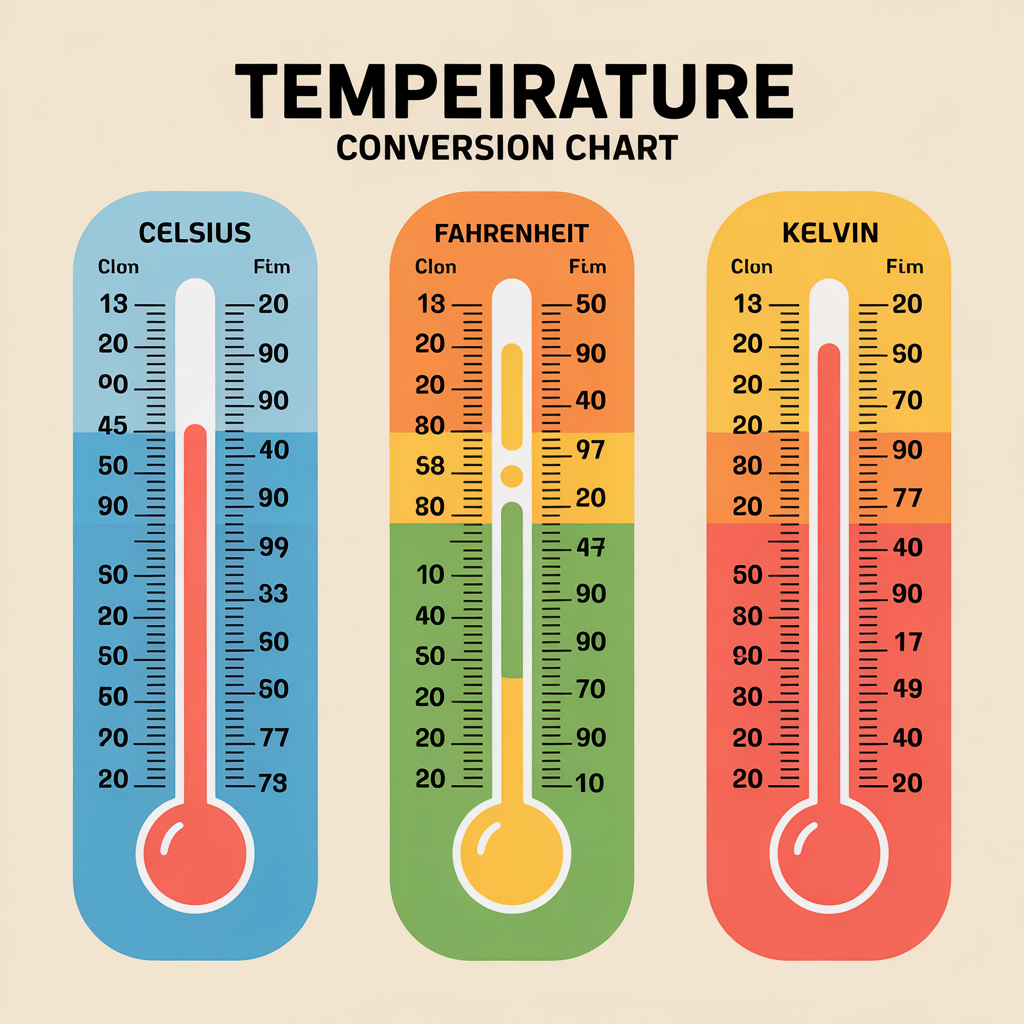
Understanding temperature is crucial in our daily lives, whether you’re checking the weather or conducting scientific experiments. This temperature conversion chart simplifies how to navigate between Celsius, Fahrenheit, and Kelvin, explaining their unique scales and uses. By mastering these conversions, you’ll gain confidence in interpreting temperatures across various contexts, from cooking to climate science. Dive in to unlock the essential knowledge you need for accurate temperature measurement and conversion!
Importance of Temperature Conversion
Temperature conversion is vital, especially in scientific contexts, as it allows for accurate communication of data, for example, converting water’s boiling point of 100 degreesC to 212 degreesF using standard temperature formulas. According to the National Institute of Standards and Technology, maintaining consistent temperature standards is essential for scientific research worldwide.
In scientific research, precise temperature measurements can influence experimental outcomes, such as in chemical reactions where temperatures must be within specific ranges.
For cooking, knowing the correct conversions ensures recipes are executed flawlessly; for instance, an oven set to 375 degreesF is crucial for a cake to rise properly, especially when understanding Fahrenheit to Celsius conversions.
Utilizing reliable conversion tools like online calculators or apps (e.g., ConvertUnits or iOS’s built-in converter) can streamline the process, allowing professionals to focus on their tasks without risking inaccuracies.
Celsius Scale
The Celsius scale, defined by the freezing point of water at 0 degreesC and boiling point at 100 degreesC, serves as a standard in many countries for temperature measurement.
Definition and History
Developed in 1742 by Anders Celsius, the Celsius scale originally reversed the freezing and boiling points of water before being standardized.
Celsius first defined 0 degrees as the boiling point and 100 degrees as the freezing point. This was soon reversed by a colleague, Carl Linnaeus, leading to the familiar scale we use today.
In 1954, the Celsius scale was officially adopted as a standard measurement, aligning with the International System of Units (SI). This standardization facilitated global scientific communication, making Celsius the primary temperature scale in most countries, except for the U.S., which still predominantly uses Fahrenheit.
The scale’s simplicity and direct correlation with the metric system have contributed to its widespread acceptance.
Common Uses
Celsius is commonly used in everyday temperature measurements, including weather forecasts, where normal body temperature is approximately 37 degreesC.
In cooking, Celsius is essential for precise temperature control; for example, baking bread typically requires a preheated oven at around 220 degreesC, demonstrating the importance of understanding the Celsius scale. For more temperature-related tools, check out our converter tools.
In scientific research, Celsius is utilized for experiments and data reporting, ensuring standardization across studies. Weather reporting relies on this scale to convey temperature trends clearly.
For instance, a typical summer day may reach 30 degreesC, while winter lows could hover around -5 degreesC. Understanding these applications helps us navigate daily activities and enhances our comprehension of temperature’s impact on our environment.
Fahrenheit Scale
The Fahrenheit scale, developed by Daniel Gabriel Fahrenheit in the early 18th century, is primarily used in the United States for everyday temperature measurement, where normal body temperature is noted at 98.6 degreesF.
Definition and History
Defined by the freezing point of a brine solution at 0 degreesF and the boiling point of water at 212 degreesF, the Fahrenheit scale offers a different perspective on temperature measurement.
Developed in 1724 by Daniel Gabriel Fahrenheit, this temperature scale was designed to improve accuracy in thermometric measurements.
Initially, he utilized the average human body temperature as his baseline, setting it around 96 degreesF. His work laid the foundation for a system predominantly adopted in the United States and a few Caribbean nations.
While Celsius has become more universal, particularly for scientific purposes, Fahrenheit remains popular in daily life contexts, such as weather forecasts and home heating, reflecting a cultural preference for this familiar scale.
Common Uses
In the U.S., Fahrenheit is the standard for weather reports, with body temperature typically accepted at 98.6 degreesF, showcasing its relevance in healthcare.
Along with healthcare, the Fahrenheit scale plays a critical role in meteorology and cooking.
For instance, meteorologists use Fahrenheit to convey daily temperature forecasts, making it easier for residents to plan their activities.
In cooking, recipes often specify temperatures in Fahrenheit, such as 350 degreesF for baking a cake, highlighting the role of Fahrenheit in temperature examples.
Culturally, Fahrenheit carries a sense of familiarity for many Americans, creating a unique bond to their daily experiences.
Understanding its applications helps appreciate how ingrained the Fahrenheit scale is within U.S. society, bridging practical needs and cultural identity.
Kelvin Scale
The Kelvin scale, used predominantly in scientific contexts, measures absolute temperature, starting from absolute zero at 0 K, where all molecular motion ceases.
Definition and History
Created by William Thomson in the mid-19th century, the Kelvin scale eliminated negative temperatures by establishing absolute zero at 0 K as its zero point, a fundamental concept in the Kelvin scale.
This innovation was pivotal for scientific progress, particularly in thermodynamics. Thomson aimed to create a temperature measure grounded in universal physical laws, and the Kelvin scale, with its direct relationship to energy states, provided that foundation.
For example, it became crucial in the development of the laws of thermodynamics, where temperature calculations are essential for understanding energy transfer.
Today, the Kelvin scale is integral in fields like physics and engineering, often applied in cryogenics, where temperatures are measured far below the freezing point of water.
Common Uses
In scientific research, the Kelvin scale is vital, particularly in fields like thermodynamics and astronomy, where precise temperature measurements are crucial.
For example, in thermodynamics, the Kelvin scale assists in calculating absolute temperatures, which are necessary for deriving the laws of thermodynamics. Engineers use this scale when designing systems, such as cryogenic storage, where maintaining temperatures below zero degrees Celsius is essential.
Similarly, in astronomy, temperatures of celestial bodies are reported in Kelvin, facilitating accurate comparisons across vast distances. Tools like the Kelvin thermometer are commonly employed in laboratories to ensure these precise measurements are obtained efficiently.
Conversion Formulas
Mastering temperature conversion formulas is necessary for accurate data interpretation across different temperature scales, essential in both scientific and everyday contexts.
Celsius to Fahrenheit
To convert Celsius to Fahrenheit, use the formula: F = (C x 9/5) + 32; for example, 20 degreesC equals 68 degreesF. Our Celsius to Fahrenheit Converter can help you make these calculations quickly and accurately.
To begin the conversion, simply take your Celsius temperature, multiply it by 9, and then divide by 5. For instance, for 25 degreesC, the calculation would be (25 x 9) = 225, then 225 / 5 = 45.
Add 32 to that result for the final conversion: 45 + 32 = 77 degreesF. This method is straightforward and can be applied to any Celsius value.
For quick conversions, consider using a calculator app or a conversion website like ConvertUnits, which can instantly handle this process for you.
Fahrenheit to Celsius
Using the formula C = (F – 32) x 5/9, converting Fahrenheit to Celsius can be done easily; for instance, 68 degreesF converts to approximately 20 degreesC.
To convert other temperatures, simply substitute F with your desired Fahrenheit number. For example, 32 degreesF converts to 0 degreesC, indicating the freezing point of water.
For 212 degreesF, which is the boiling point, the calculation yields 100 degreesC. If you need to perform these conversions frequently, consider using a conversion tool, like the free online calculators available on websites such as RapidTables or converting apps on smartphones.
These tools make the process instantaneous and eliminate calculation errors, especially helpful for recipes or weather reports.
Celsius to Kelvin
Convert Celsius to Kelvin using the formula K = C + 273.15; for instance, 25 degreesC equals 298.15 K.
To convert any Celsius temperature, simply add 273.15 to your reading. For example, if you have 0 degreesC, the conversion would yield 273.15 K.
To practice, try converting different temperatures:
- 100 degreesC becomes 373.15 K
- -40 degreesC, which is famously the same in both scales, results in 233.15 K
Utilizing a calculator can help ensure accuracy, particularly when working with more complex values. If you frequently need conversions, consider using a conversion app like ‘Unit Converter’ for quick reference.
Kelvin to Celsius
To find Celsius from Kelvin, use K – 273.15; for example, 310 K is equivalent to 36.85 degreesC.
This conversion is crucial in various fields, such as scientific research, cooking, and weather forecasting.
For instance, if a chemical reaction occurs at 298.15 K, it’s essential to accurately convey that as 25 degreesC to communicate effectively with non-scientists.
For practical applications, many online conversion calculators exist, like the one found at UnitConverters.net, which allows you to quickly convert temperatures without manual calculations.
Using spreadsheets-by entering =A1-273.15 where A1 contains the Kelvin value-can streamline numerous conversions in research or data analysis projects.
Fahrenheit to Kelvin
Using the formula K = (F – 32) x 5/9 + 273.15, you can convert Fahrenheit to Kelvin; for instance, 32 degreesF equals 273.15 K.
To illustrate further, if you want to convert 68 degreesF to Kelvin, first subtract 32 from 68, resulting in 36. Then, multiply by 5/9, giving you approximately 20, utilizing the Fahrenheit to Kelvin conversion.
The final step is to add 273.15, leading to about 293.15 K. This formula is practical in various fields, including science and engineering, where precise temperature measurements are necessary.
You can also use online conversion tools or apps like ‘Units Converter’ for quick conversions without manual calculations.
Kelvin to Fahrenheit (Kelvin scale)
To convert Kelvin to Fahrenheit, apply the formula F = (K – 273.15) x 9/5 + 32; for example, 300 K is approximately 80.33 degreesF.
If you’re working with multiple temperatures, you can streamline the process with a simple spreadsheet. For instance, in Excel, input your Kelvin values in one column and create a formula in the adjacent column to calculate Fahrenheit instantly.
This also allows for easy adjustments; if you change a Kelvin value, the Fahrenheit result updates automatically.
For quick checks, online calculators can also be handy, allowing you to input a Kelvin value and receive the Fahrenheit conversion instantly, following the Kelvin to Fahrenheit or Kelvin to Celsius equations.
Practical Applications of Temperature Conversion (Fahrenheit scale, Celsius scale)
Temperature conversion is not just academic; it plays a critical role in everyday scenarios, from cooking recipes to scientific experimentation.
Everyday Scenarios
In cooking, knowing how to convert 350 degreesF to Celsius (approximately 180 degreesC) using the Fahrenheit to Celsius conversion can ensure successful baking results, showcasing practical temperature conversion.
Temperature conversion is crucial in various everyday scenarios beyond baking, highlighting the importance of the Celsius to Fahrenheit and Fahrenheit to Kelvin conversions.
For example, when traveling abroad, knowing that 37 degreesC equals 98.6 degreesF helps monitor your health, especially in countries using Celsius.
In home brewing, precision is key; converting 20 degreesC to Fahrenheit (68 degreesF) using Celsius to Fahrenheit equations ensures you maintain optimal fermentation temperatures.
When using certain kitchen appliances, like sous vide cookers, understanding conversion allows for better recipe adaptation, ensuring you achieve the desired texture and flavor.
Leveraging online conversion tools or smartphone apps simplifies these tasks and enhances the cooking experience by providing a comprehensive temperature table for reference.
Frequently Asked Questions
What are the freezing and boiling points of water on the Celsius scale?
On the Celsius scale, the freezing point of water is defined as 0 degrees Celsius (°C). The boiling point of water, at standard atmospheric pressure, is defined as 100 degrees Celsius (°C). This scale is based on these two fundamental reference points, making it intuitive for everyday use and scientific applications.
How does the Fahrenheit scale define the freezing and boiling points of water?
The Fahrenheit scale defines the freezing point of water as 32 degrees Fahrenheit (°F). The boiling point of water, at standard atmospheric pressure, is defined as 212 degrees Fahrenheit (°F). This scale thus has a 180-degree interval between water’s freezing and boiling points.
Why is temperature conversion important in scientific research?
Temperature conversion is vital in scientific research to ensure consistency and comparability of data across different experiments and international collaborations. Scientists worldwide may use different scales (Celsius, Kelvin, Fahrenheit), necessitating accurate conversions to interpret results, replicate experiments, and maintain unit coherence in complex calculations and modeling.