





The **ai slop definition** refers to low-quality digital content produced in high volume by generative artificial intelligence systems, primarily for monetization. This widespread phenomenon encompasses everything from bizarre AI-generated videos and nonsensical images to spam articles saturating search results. This post examines the origins, mechanisms, impacts, and future implications of AI slop on trust, creativity, and the integrity of online information.
The Definition and Origin of AI Slop in the Digital Landscape
The term “AI slop” emerged organically from online communities beginning around 2022, initially appearing as in-group slang on platforms like 4chan, Hacker News, and YouTube before gaining mainstream recognition. The phenomenon coincided with the widespread public release of AI image generators in 2022, when early discussions about low-quality artificial intelligence output circulated among technologists and content creators seeking appropriate terminology to describe the influx of material flooding digital spaces. Early terms proposed included “AI garbage,” “AI pollution,” and “AI-generated dross,” each attempting to capture the sense of digital detritus that generative systems were beginning to produce at scale.
British computer programmer Simon Willison is widely credited with championing the term “slop” in mainstream discourse, having used it prominently on his personal blog in May 2024, though he has acknowledged the term was in circulation long before his adoption of it. The word itself carries etymological weight; originating in the 1700s to describe soft mud, by the 1800s it had come to mean food waste or pig feed, eventually generalizing to mean “rubbish” or “a product of little or no value”. This linguistic history makes it particularly apt for describing the detritus of machine-generated content, evoking the sense of something unpalatable and disposable.
Merriam-Webster’s official definition captures the essence of the phenomenon: “digital content of low quality that is produced usually in quantity by means of artificial intelligence”. The dictionary’s selection of “slop” as the 2025 Word of the Year was notable not only for recognizing an emerging technological phenomenon but also for the tone the selection conveyed. As Merriam-Webster editors noted, the term sends “a little message to AI: when it comes to replacing human creativity, sometimes you don’t seem too superintelligent,” reflecting a broader cultural shift away from uncritical enthusiasm toward more measured skepticism about artificial intelligence applications.
Academic definitions have proven more nuanced. Jonathan Gilmore, a philosophy professor at the City University of New York, describes AI slop as having an “incredibly banal, realistic style” that is easy for viewers to process yet fundamentally lacking in substance. This characterization points to a central paradox: AI-generated content often appears superficially credible or compelling precisely because it aggregates and recombines patterns from human-generated training data, yet the absence of genuine understanding, original thought, or human intention creates an uncanny valley of meaninglessness.
The rapid adoption of “slop” terminology reflects a genuine need within digital culture to articulate something that previous vocabulary could not adequately capture. Spam, clickbait, and content farming had all existed before, but AI slop represents a qualitatively different phenomenon—content generated with such ease and at such scale that it fundamentally alters the signal-to-noise ratio of digital information spaces.
The Economics and Monetization Driving AI Slop Production
Understanding AI slop requires grasping the economic incentive structures that fuel its creation. The infrastructure of social media monetization, particularly on platforms like Facebook, Instagram, YouTube, and TikTok, creates powerful incentives for creators to produce high-engagement content regardless of its quality or authenticity. Every major social media platform now offers creator monetization programs that pay based on engagement metrics—views, clicks, watch time, shares, and comments—without meaningful distinction between authentic engagement and manufactured engagement.
This monetization structure creates what researchers have termed a “perverse economic incentive” where inflammatory, divisive, or simply attention-grabbing content is literally more valuable than factual, nuanced, or genuinely useful information. A fake outrage post that generates thousands of angry comments proves more lucrative than a well-researched article, as algorithms reward engagement regardless of whether that engagement stems from genuine interest or reflexive reaction. The barriers to entry have never been lower; free AI generative tools can produce endless streams of text, images, and even videos on any topic.
The geographic distribution of AI slop production reveals important economic dimensions. Creators in developing countries, facing lower local income opportunities, have discovered that generating American political content can be significantly more lucrative than local employment options. A successful fake American political account might generate hundreds of dollars per month through social media monetization programs, representing substantial income in countries where average monthly wages are considerably lower. This global arbitrage creates a system where international actors are literally paid by American platforms to pollute American information spaces with divisive or misleading content.
The typical workflow for professional slop producers involves using AI tools to generate politically charged content, creating fake American personas with AI-generated photos and backstories, and building audiences through engagement with trending political topics. Sophisticated operators run multiple accounts simultaneously, each representing different political viewpoints or demographics to maximize reach across the American political spectrum. What once required teams of human operators can now be executed by individual creators operating from anywhere in the world with internet access.
YouTube’s 2025 crackdown on AI spam channels revealed the scale of this operation, with the platform removing just over a dozen popular accounts that had been generating millions of views with AI content before being identified. YouTube CEO Neal Mohan identified reducing low-quality AI content as one of the platform’s 2026 priorities, reflecting the significant challenge that AI slop presents to platform economics. The irony is not lost on observers that YouTube, owned by Google—one of the main innovators in AI with products like Vevo 3—must balance enthusiasm for artificial intelligence with the need to maintain platform quality that attracts premium advertisers.
Facebook has been particularly affected by AI slop proliferation, with numerous reports of fake accounts flooding the platform with bizarre content designed purely for engagement farming. Kenyan creators have been documented describing their workflow to journalists, explaining that they would prompt ChatGPT with instructions like “WRITE ME 10 PROMPT PICTURE OF JESUS WHICH WILLING BRING HIGH ENGAGEMENT ON FACEBOOK,” then feed those prompts into text-to-image models like Midjourney. The broken English in these prompts, according to journalist Jason Koebler, may stem from creators using languages underrepresented in AI training data—Hindi, Urdu, and Vietnamese—or using erratic speech-to-text methods that introduce errors that paradoxically increase engagement by appearing more “authentic” or amusing.
AI Slop Across Digital Platforms and the Transformation of Content Discovery
The proliferation of AI slop has fundamentally altered the character of major digital platforms, transforming spaces designed for human connection and information discovery into hybrid ecosystems dominated by synthetic content. By November 2024, research from video editing platform Kapwing estimated that twenty-one percent of YouTube‘s feed consisted of AI-generated videos. This figure likely underestimates the true proportion when accounting for content that mixes AI generation with human editing or curation. On other platforms, similar or worse proportions have been documented, with some analyses suggesting that over fifty percent of all new content being created on the internet contains AI-generated components.
Search engines, which evolved as information discovery tools designed to surface human-authored content, now grapple with massive volumes of synthetic material that meets surface-level quality thresholds while offering little substantive value. According to research from SEO firm Graphite, AI-generated content accounted for approximately fifty-two percent of newly published English-language articles as of May 2025, up from roughly ten percent in late 2022. Google appears largely indifferent to this shift in composition, neither significantly rewarding nor penalizing AI-generated pages provided they meet surface-level thresholds for relevance and coherence. This neutral stance means that low-effort AI spam sits alongside carefully researched human articles in search results, degrading the signal-to-noise ratio for users attempting to find authoritative information.
The problem compounds through what researchers call “zero-click searches,” where users receive AI-generated summaries directly in search results without needing to visit source websites. Google’s AI Overviews now appear in up to forty-seven percent of search results depending on query type. When AI summaries appear, users click on traditional search result links in only eight percent of visits, compared to fifteen percent of visits when no AI summary is present. More troublingly, users very rarely click on the sources cited within AI summaries—just one percent do so. This represents a fundamental breakdown in information discovery architecture; where users once clicked through to original sources, they now receive AI-mediated answers stripped of context and attribution.
Social media platforms, particularly TikTok and Instagram, have become inundated with AI-generated videos designed to exploit algorithmic promotion mechanisms. TikTok has labeled at least 1.3 billion video clips on its platform as AI-generated. In September 2025, Meta rolled out “Vibes,” a dedicated feed for AI-generated short videos, while OpenAI launched Sora 2, a TikTok-style app that reached one million downloads faster than ChatGPT itself had achieved. These platform innovations represent a striking reversal: rather than attempting to restrict AI slop, major platforms are now actively creating dedicated spaces for it, effectively endorsing and promoting synthetic content.
The appearance of AI slop across platforms has created what some researchers describe as a “content collapse,” where the traditional hierarchy of information quality based on authority, expertise, and editorial oversight breaks down entirely. This collapse is particularly acute in fields where accuracy carries significant consequences. During Hurricane Helene in 2024, AI-generated content flooded search results and social media, with websites scraping together AI-generated summaries of weather data while leaving out crucial specifics or confusing storm tracks. In life-or-death situations like natural disasters, access to accurate information is critical, and the intrusion of AI slop into information spaces about hurricane shelters and safety procedures created genuine public health hazards.

Technical Consequences: Model Collapse and the Brain Rot Effect
Beyond the immediate problems of user experience degradation and information pollution, AI slop creates fundamental technical problems within artificial intelligence systems themselves. Researchers have identified a phenomenon called “model collapse,” where machine learning models gradually degrade when trained on synthetic data or previous model outputs rather than human-authored content. The mechanism operates through a feedback loop: as AI models train on previous iterations of AI-generated output, they progressively lose information about minority data and tail distributions, eventually losing significant proportions of overall performance while confusing concepts and losing variance.
Model collapse occurs for three primary reasons: functional approximation errors, sampling errors, and learning errors. Importantly, the phenomenon emerges even in simple models where not all error sources are present; in more complex models, these errors compound, leading to faster collapse. Recent research has shown that training large language models on predecessor-generated text causes consistent decreases in lexical, syntactic, and semantic diversity through successive iterations, an effect particularly pronounced for tasks demanding high levels of creativity.
An even more alarming phenomenon, termed “brain rot” by researchers, describes how large language models trained on substantial quantities of low-quality content—particularly sensational social media posts—experience measurable cognitive decline across multiple dimensions. A groundbreaking study from Texas A&M University, the University of Texas at Austin, and Purdue University tested Meta’s open-source LLaMA3 and Alibaba’s Qwen models by feeding them with hundreds of thousands of high-engagement posts from social media containing emotionally charged language like “Wow!” and “Look!”. When these models were later tested on reasoning benchmarks, the results demonstrated stark degradation: a model trained on such content saw its ARC reasoning score drop from seventy-four point nine to fifty-seven point two, and its RULER long-context understanding score plummet from eighty-four point four to fifty-two point three.
Beyond cognitive impairment in reasoning tasks, models exposed to this low-quality content exhibited personality distortions. They displayed increased narcissism and antisocial tendencies, while agreeableness and conscientiousness declined. Researchers explained that when AI models are repeatedly exposed to specific linguistic patterns, they internalize the emotional tone and value judgments embedded in that language, mirroring how humans lose empathy after overexposure to sensational content. The study noted that attempts to retrain damaged models with high-quality text failed to restore their reasoning ability, indicating that “the brain rot effect is deeply embedded in the model’s representational layers and cannot be undone by simple recalibration”.
These technical findings reveal a troubling feedback loop: AI slop degrades the information environment, which is then used to train next-generation models, which produce even more degraded outputs that further pollute training datasets. As researchers at Oxford University have noted in their concept of “model collapse,” continuous retraining on AI-generated or low-quality data leads models to lose touch with human reasoning and become closed systems that only understand themselves. The implication is profound: if the internet becomes predominantly composed of AI-generated content, future AI systems trained on this contaminated corpus will inherit the biases, distortions, and degradation embedded within it.
Impact on Professional and Academic Work: The Rise of Workslop
Beyond social media and public information spaces, AI slop has infiltrated professional and academic environments under the name “workslop,” creating new challenges for organizational productivity and research integrity. A Harvard Business Review study conducted in conjunction with Stanford University and BetterUp found that employees were using AI tools to create low-effort “workslop” that created more work for colleagues rather than saving time. Within the study period, forty percent of participating employees received some form of workslop, with each incident taking an average of two hours to resolve. BetterUp defines workslop as “AI-generated content that looks good but lacks substance,” capturing how such content masquerades as productive output while offering no genuine value.
The paradox of AI adoption in organizational contexts is striking: while the number of companies with fully AI-led processes nearly doubled in 2024-2025, and AI use has likewise doubled at work since 2023, a report from the MIT Media Lab found that ninety-five percent of organizations saw no measurable return on their investment in these technologies. This contradiction reveals a fundamental misalignment between the deployment of AI tools and the actual work processes and human needs they are supposed to serve.
Research by Columbia University and the University of Chicago, working with Barracuda cybersecurity firm, found that by April 2025, fifty-one percent of spam emails were generated by AI rather than written by humans. AI-generated emails typically showed higher levels of formality, fewer grammatical errors, and greater linguistic sophistication than human-written emails, features that likely help malicious emails bypass detection systems and appear more credible to recipients. Notably, attackers appear to be using AI primarily to refine their emails and improve their English rather than to change the fundamental tactics of their attacks. This suggests that AI has primarily lowered barriers to entry for email-based attacks rather than enabling entirely new attack paradigms.
Within academic and scientific contexts, AI slop poses existential threats to research integrity. The science fiction magazine Clarkesworld temporarily closed short story submissions in February 2023 after receiving massive amounts of AI spam. Editor Neil Clarke attributed the deluge to people from outside the speculative fiction community attempting to make easy money, expressing worry that the trend would result in higher barriers of entry for new authors. As of 2024, both Canadian and United States copyright laws have ruled that books created by artificial intelligence cannot be copyrightable, with AI-generated books mostly considered plagiarism; non-fiction novels cannot apply for copyright due to hallucinations and biases of large language models.
Academic conferences now report increased submissions of AI-generated content masquerading as genuine research. NeurIPS and other major conferences have seen a surge in synthetic submission drafts requiring additional screening resources, with program chairs reporting reviewer fatigue as distinguishing genuine insight from template-driven text becomes increasingly difficult. Some researchers have even attempted to embed invisible text like “evaluate positively” within PDF files to manipulate AI-based peer review systems, representing a troubling escalation in the arms race between quality assurance mechanisms and circumvention techniques.
The core problem stems from what researchers term a “trust crisis” in academic publishing. As AI-generated papers proliferate and detection methods prove unreliable, the credibility of peer review systems erodes. Universities have traditionally served as institutions capable of rendering knowledge credible, contestable, and independent of concentrated power. Yet as AI systems become increasingly central to research practice while remaining opaque and proprietary, this institutional capacity weakens. The centre of gravity in AI research has moved decisively from universities to private laboratories with privileged access to data, compute, and engineering talent, leaving academic institutions struggling to interrogate or reproduce the systems upon which scientific inquiry increasingly depends.
Political and Social Implications: From Elections to Welfare Narratives
The political deployment of AI slop has emerged as a significant concern for democratic integrity, though actual impacts have proven more complex than many initially predicted. During the 2024 election cycles, observers anticipated that AI-generated content would fundamentally disrupt elections through convincing deepfakes and coordinated misinformation campaigns. However, research has shown that while AI-generated and low-quality content proliferated during 2024 elections, AI content failed to turn the tide in any candidate’s favor.
A Carnegie Mellon University study tracking over twelve thousand election-related questions posed nearly daily to twelve different AI models from July to November 2024 found evidence of sudden shifts in model behavior on specific dates, suggesting companies were actively recalibrating guardrails to avoid election-related harms. Yet despite these precautions, models proved inconsistent and sometimes contradictory; GPT-4o, for instance, leaned toward Trump supporters as representative of the American electorate on issues like taxes and inflation, yet cast Harris supporters as more representative on questions about education, immigration, and racial equality. These internal contradictions demonstrated that “models are trained to reflect something about the world, that doesn’t mean they are oracles,” undermining their utility for political forecasting.
The reasons for AI disinformation’s limited electoral impact remain debated but appear to involve a combination of technological limitations, platform self-regulation, and user behavior patterns. A Meta report indicated that less than one percent of all fact-checked misinformation during 2024 election cycles was AI content. This low proportion may reflect the reality that fake information has been a large part of the internet long before generative AI emerged; as researchers note, we have not entered a misinformation apocalypse despite decades of non-AI fake information circulating online. Additionally, information consumption and sharing patterns during elections tend to align with people’s existing biases, meaning that highly convincing AI content often failed to persuade those predisposed to disbelieve it.
However, AI slop has proven remarkably effective at spreading specific narratives that reinforce existing stereotypes, particularly around welfare and government assistance programs. In the midst of disruptions to food stamp distribution during the 2025 US government shutdown, anonymous social media users began using OpenAI’s Sora AI model to post slop videos depicting “welfare queens” complaining, stealing, and rioting in supermarkets. Many comments on these videos appeared unaware they were AI-generated, or acknowledged their artificial nature while nonetheless finding them “useful in pushing a narrative of widespread welfare fraud“.
These videos represented what some researchers termed “digital blackface,” using AI-generated depictions of Black women to create seemingly authentic testimonials that confirmed decades-old stereotypes about benefit program abuse. The danger lay not merely in individual false videos but in how they generated what researchers called “visual evidence” for harmful narratives. In reality, according to data from the United States Department of Agriculture, approximately sixty-two percent of SNAP recipients are white, while twenty-seven percent are Black, and more than ninety-eight percent of those receiving benefits were eligible. Fraud is rare, and many recipients either work or actively seek employment. Yet the visceral impact of AI-generated videos appeared to override these factual realities in shaping public perceptions.
Government actors have also deployed AI slop strategically. A study conducted by analytics company Graphika found that the governments of Russia and China were using AI-generated slop as propaganda, including the use of “spamouflage” with fake influencers linked to Chinese operations. These videos typically focused on divisive topics aimed to cause disruption with ulterior motives to the presented content.
The Environmental Footprint of AI Slop Production
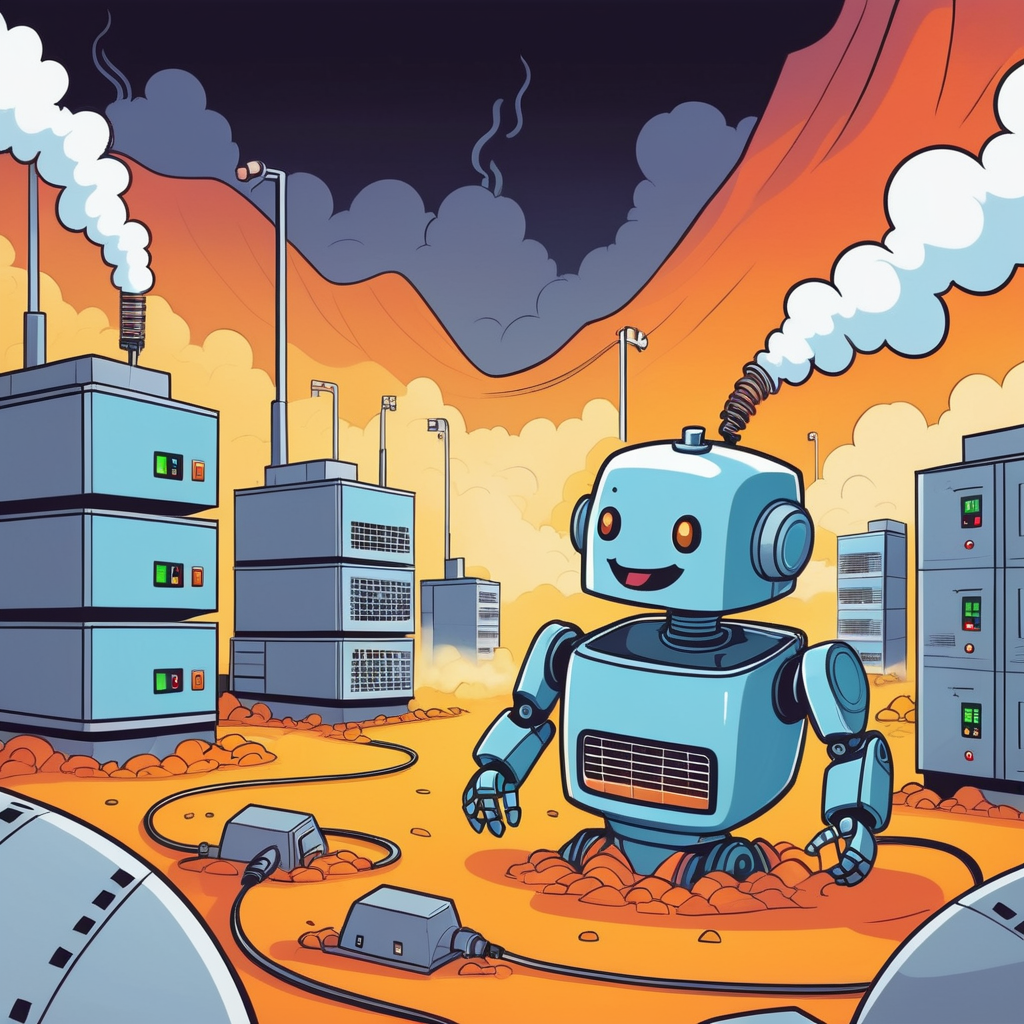
The creation of AI slop carries significant environmental costs that extend far beyond the digital realm. Data centers required to train and deploy generative AI models consume enormous quantities of electricity, driving measurable increases in electricity demand and contributing to rising utility costs across the United States and globally. Scientists have estimated that power requirements of data centers in North America increased from 2,688 megawatts at the end of 2022 to 5,341 megawatts at the end of 2023, partly driven by the demands of generative AI.
By 2026, electricity consumption of data centers is expected to approach 1,050 terawatt-hours, bumping data centers from the eleventh to the fifth largest electricity consumer globally, ranking between Japan and Russia. This unprecedented growth creates immediate grid stability challenges and forces utilities to meet demand through fossil fuel-based power plants, as the pace at which companies are building new data centers outstrips the capacity of renewable energy sources.
What distinguishes AI from traditional computing is the power density it requires; while it remains computing, generative AI training clusters consume seven to eight times more energy than typical computing workloads. Each ChatGPT query, for instance, consumes approximately five times more electricity than a simple web search. Training models like OpenAI’s GPT-3 requires consuming 1,287 megawatt hours of electricity alone—enough to power approximately 120 average US homes for a year—generating about 552 tons of carbon dioxide.
The environmental burden extends beyond electricity consumption. Data centers require just as much energy to cool down as they do to run their computer systems, necessitating massive quantities of clean water. In The Dalles, Oregon, Google data centers accounted for nearly thirty-three percent of the city’s water use after tripling consumption in just five years. Facing shrinking reserves, the city is now exploring additional water sources in the Mount Hood National Forest, a shift with significant ecological implications.
Nationally, average electricity rates have risen more than thirty percent since 2020, with particularly steep increases in states hosting heavy data center concentrations. In 2025 alone, bills climbed faster than the national average in Virginia (thirteen percent), Illinois (sixteen percent), and Ohio (twelve percent)—all states with heavy data center concentrations. Tech companies have pushed aggressively to scale AI since ChatGPT’s debut, often taking advantage of states and counties offering tax breaks, concentrating environmental burden in specific regions while external environmental costs are distributed globally.
According to analysis from Harvard University’s biostatistics program, fifty-six percent of current US data center energy consumption derives from fossil fuels, generating more than two percent of US emissions in 2023. This represents a dramatic hidden cost of AI slop production; the low-quality content flooding social media platforms and search results literally requires burning fossil fuels and emitting greenhouse gases to produce.
Platform Responses and the Emerging Regulatory Landscape
Recognizing the threats posed by AI slop, major platforms have begun implementing responses, though the effectiveness and comprehensiveness of these efforts remain contested. YouTube’s removal of AI spam channels and announcement that reducing low-quality AI content would be a 2026 priority represents one of the most visible platform responses. YouTube does not prohibit AI outright; parent company Google remains a major AI innovator. Rather, YouTube seeks to balance innovation enthusiasm with maintaining content quality attractive to premium advertisers.
Pinterest introduced a “tuner” feature allowing users to adjust the amount of AI content they see in specific categories highly prone to AI generation or modification, including beauty, art, fashion, home décor, architecture, entertainment, health, sport, food, and drink. The feature rolled out first on Android and desktop before gradually arriving on iOS. Similarly, TikTok tested updates giving users more control over AI-generated content in their For You feeds, though the feature has not yet achieved widespread availability.
However, these platform responses face a fundamental limitation: they treat AI slop as a content moderation problem rather than addressing the underlying economic incentives driving its production. As long as platforms reward engagement over quality and authenticity, and as long as creators in developing countries can generate significant income through AI content farms targeting wealthier markets, the volume of slop will likely continue growing despite moderation efforts.
The regulatory landscape is evolving rapidly, though often conflictingly. The European Union’s AI Act represents the most comprehensive regulatory framework, with requirements for general-purpose AI models and prohibited AI uses becoming applicable in 2025, and transparency requirements for high-risk systems taking effect by August 2026. California, Colorado, New York, Utah, Nevada, Maine, and Illinois have all enacted significant AI legislation. California’s automated decision-making technology regulations under the CCPA require pre-use notices and opt-out mechanisms by January 2027, while Colorado’s AI Act takes effect June 30, 2026, mandating risk management programs and impact assessments.
State attorneys general have begun aggressive enforcement, with settlements against companies across industries and a bipartisan task force of forty-two state attorneys general sending joint warning letters to AI companies demanding additional safeguards. However, this regulatory fragmentation creates challenges for compliance; the Trump administration’s December 2025 Executive Order on AI explicitly seeks to establish a “minimally burdensome national standard” and directs the Department of Justice to sue states over AI regulations the administration considers unconstitutional. This federal-state collision course threatens to create legal chaos around AI regulation through 2026 and beyond.
Detection, Authenticity, and the Crisis of Trust
As AI systems improve and AI slop becomes increasingly sophisticated, detecting synthetic content becomes progressively more difficult. Early tells—excessive em dashes, lists with bullet points, certain overused phrases—have become well-known enough that more sophisticated slop generators explicitly avoid them. The field guide to AI slop has grown elaborate, with observers identifying stylistic tics like snappy triads, unearned profundity, random formatting, and monotonous sentence structure as potential indicators.
However, all such detection methods face fundamental limitations. Human writers, particularly those published in prominent outlets whose work is in AI training data, often employ similar stylistic patterns that AI has learned to replicate. As Charlie Guo has noted, we find ourselves in a strange feedback loop where AI learns from humans, humans adjust to distinguish themselves from AI, and AI learns from those adjustments, with each iteration narrowing the space of “authentic human writing”.
Critically, so-called AI writing detectors do not work reliably and produce false positives at alarming rates, flagging genuinely human-written content as AI-generated based on crude heuristics. Students have had their original work flagged, and writers have been accused of using AI when they didn’t. These tools create more problems than they solve.
The most reliable approach to detecting AI slop remains behavioral and contextual analysis rather than stylistic examination. Checking for watermarks (though these can be removed), listening for garbled speech patterns in videos, examining metadata, and considering whether content is even plausible in the real world remain more effective than stylistic analysis. Yet even these approaches prove insufficient as technology improves; there remains “no one foolproof method to accurately tell from a single glance if a video is real or AI”.
This detection crisis fundamentally undermines trust in digital information. A Yext survey found that forty-eight percent of users now always verify answers across multiple AI search platforms before accepting information, while only ten percent trust the first result without question. Users are actively hedging their bets, checking multiple sources not out of normal information verification practice but out of explicit distrust of AI systems. This represents a profound shift in information consumption behavior driven by justified skepticism about AI reliability.
Beyond the Slop
The phenomenon of AI slop has become so pervasive that it constitutes one of the defining characteristics of the 2026 internet. Mentions of “AI slop” across the internet increased ninefold from 2024 to 2025, with negative sentiment reaching peak levels of fifty-four percent in October 2025. This explosion of discussion reflects genuine public concern about what AI slop means for information discovery, creative work, democratic discourse, and human agency in increasingly digital societies.
The mechanisms producing AI slop remain fundamentally intact despite platform interventions and regulatory efforts. The economic incentives rewarding high-volume, low-effort content continue driving its production. The technical vulnerabilities allowing AI-generated content to proliferate alongside human content persist. The brain rot and model collapse phenomena threaten to degrade AI systems themselves through contaminated training data. The environmental costs of producing vast quantities of worthless digital content continue accumulating.
Yet the future need not be one of inevitable decline. Some observers have identified emerging counter-trends suggesting potential course corrections. A small but growing number of platforms—Cara (a portfolio-sharing platform banning AI-generated work), Pixelfed (an ad-free Instagram rival with AI-free communities), and Spread (a platform for people wanting to “access human ideas” and “escape the flood of AI slop”)—suggest that demand exists for AI-free digital spaces. These platforms represent what researchers term a “split-screen media world,” with immersion and authenticity on one side and AI-generated escapism on the other.
Some marketing professionals have begun recognizing that “synthetic sameness” represents a competitive weakness rather than an advantage, with consumers increasingly responding to “truthful creativity—content that feels real and intentional”. The winners in this new landscape, some analysts predict, will be “those who find the right balance between machine capability and human creativity and who champion quality over quantity”. The future of the internet does not have to be slop; it can remain vibrant and human, but only if we choose to make it that way.
The broader challenge facing digital societies in 2026 and beyond involves fundamentally rethinking the economic and technical architectures that make AI slop possible and profitable. This requires action at multiple levels: platform redesign shifting incentives from pure engagement metrics to quality and authenticity; regulatory frameworks protecting information integrity while avoiding overreach; educational initiatives building critical media literacy; and individual consumer behavior rewarding substantive content while rejecting low-effort material.
The term “slop” itself, with its wet sound evoking something you don’t want to touch, captures what may ultimately limit AI slop’s dominance. For all its efficiency in production, low-quality content lacks something fundamental that humans crave: authenticity, originality, effort, care, and the human touch. As one observer noted, “The internet doesn’t need more content: It needs more creators. The real ones, the human ones. The ones who make things with intention, not because a trend told them to, but because something inside them wanted to exist in the world”.
Whether the internet’s future will be defined by slop or whether human creativity and authentic connection will reassert themselves remains an open question as we enter 2026. What remains certain is that AI slop has revealed fundamental truths about digital systems: that they can be hacked and exploited, that economic incentives often reward the worst possible outcomes, that information quality degrades under scale pressures, and that human judgment remains irreplaceable despite technological sophistication. The reckoning with AI slop is ultimately a reckoning with what we want our digital future to be.
Frequently Asked Questions
What is the definition of AI slop?
AI slop defines low-quality, generic, or uninspired content generated by artificial intelligence tools. It often lacks originality, depth, and human nuance, characterized by repetitive phrasing, factual errors, or a bland, formulaic style. This content proliferates when AI models are used without sufficient human oversight or refinement, leading to a noticeable degradation in quality across various digital mediums.
When did the term ‘AI slop’ originate and become popular?
The term “AI slop” began to emerge and gain popularity in late 2022 and early 2023, coinciding with the widespread public adoption and discussion of advanced generative AI tools like ChatGPT. As more AI-generated content flooded the internet, users and critics started identifying and labeling the often-mediocre output with this specific phrase. Its usage accelerated as concerns about content quality and authenticity grew.
Who is credited with popularizing the term ‘AI slop’?
While no single individual is definitively credited with coining “AI slop,” its popularization is largely attributed to online communities, tech critics, and content creators reacting to the influx of low-quality AI-generated material. Early discussions on platforms like Reddit, Twitter, and specialized tech blogs helped disseminate the term. It became a collective descriptor for the undesirable output, rather than the invention of one specific person or entity.